Law enforcement across the United States remains highly decentralized, with more than 18,000 independent agencies operating with limited real-time interagency communication. This fragmentation creates persistent operational challenges: critical information may not reach neighboring jurisdictions in time, investigative leads often remain siloed, and officers face increased risks in the field. Studies continue to highlight gaps in interoperability, coordination, and secure data exchange as major obstacles to effective policing.
The Ongoing National Challenge of Information Sharing
Federal assessments reinforce this reality. A 2023 U.S. Department of Homeland Security report notes that “the ability to share information in a timely, secure, and actionable manner remains a critical challenge,” while the Government Accountability Office found that the nation’s Information Sharing Environment “continues to face barriers to effective information sharing,” limiting the timely exchange of actionable intelligence.
At the same time, organized crime, online exploitation, human trafficking, and other multi-jurisdictional matters continue to evolve faster than traditional communication methods can accommodate, making secure, real-time cross-agency information sharing essential.
New Jersey’s Statewide Solution
To address these challenges, the State of New Jersey, led by the New Jersey State Police (NJSP), decided to take a major step forward and implement an innovative approach to this national challenge, the statewide “Law Enforcement Notification and Sharing” platform (OPS LENS). In the summer of 2024, this secure law enforcement network directly connected, for the first time, all local, county, and state officers and agencies in real time, providing a unified framework for communication, intelligence sharing, and operational coordination.
“This wasn’t about improving the margins—it was about solving the problem. We made a conscious decision to break from outdated models, take the necessary steps forward, and implement a system that delivers real-time, secure collaboration across every level of law enforcement agency and member.” says Major Michael Flory of the New Jersey State Police
Officers can now share updates instantly through direct, group, or multi-agency channels. The platform supports secure multimedia—images, video, and documents—all archived and indexed for rapid retrieval. From patrol officers to investigators, users maintain situational awareness across jurisdictions without restriction. With the click of a button, information is deployed to one agency and 10 officers or the entire state. No delays and instant response.
“The goal of the system was to provide an easy-to-use, secure and scalable method to finally bring all law enforcement together, ensuring valuable time was no longer lost.” says George Chopek, former NJ law enforcement executive and principal officer for Online Policing Solutions, Inc., the oversight and management group for the platform.
Within the first week of the platform’s statewide deployment on July 1, 2024, success followed quickly. For example, numerous officers and agencies from multiple counties collaborated to dismantle an organized, cross-jurisdictional vehicle theft crew. The rapid sharing of critical information brought investigators together in days—where traditionally, connecting these cases across jurisdictions could have taken months.
Real-Time Communication and Multimedia Intelligence
At its core, OPS LENS features an officer-contributed intelligence database. Each submission not only notifies recipients in real time while allowing for instant response but adds to a continuously expanding repository. Advanced search—including keyword, image-based, and AI-assisted queries—enables users to quickly identify connections across cases.
“What that means in practice: a detective can upload a photo and search across every notification in the system for visually similar content. The AI does the matching. You’re not keyword searching anymore — you are image searching across a secure officer-controlled database.” explains Michael Bunnano, one of the chief engineers behind the development of the platform.
Specialized sections support additional investigation databases, including child luring, missing persons, and human trafficking to name a few, providing structured access while maintaining oversight across agencies.
Integrating Critical Civilian Partners
OPS LENS also allows integration of civilian assets—hospitals, transportation hubs, and other key facilities—into notification chains. This ensures all relevant stakeholders receive timely, actionable intelligence, enhancing situational awareness and coordinated responses.
“If a child goes missing, information can be shared instantly with officers, hospitals, and other partners. It’s a new generation of collaboration in New Jersey,” says Steven O’Neill, OPS VP and former NJ HIDTA Task Force Commander.
Rapid Deployment and Scalable Design
The platform is built for rapid onboarding, allowing agencies to connect within minutes with no infrastructure requirements. While fully supporting statewide operations, OPS LENS is also designed for regional and multi-state expansion. Numerous federal partners, regional intelligence centers and agencies—including in the State of New York—are already becoming active participants, enabling seamless coordination not only across New Jersey, but beyond its borders.
Transforming Operations: From Delayed Sharing to Instant Intelligence

OPS LENS consolidates communication and intelligence into a single, continuously updated system. Officers and analysts can access and act on intelligence as it develops rather than waiting hours or days for traditional channels. Multi-jurisdictional cases—ranging from organized theft rings to missing children to homicides—are now resolved more efficiently.
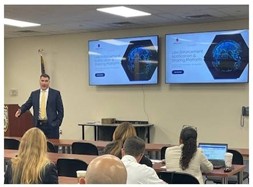
2026 – Human Trafficking Seminar – NJSP LENS Discussion
“We use it every day—it’s just the way it should have always been,” said one detective during a 2026 regional human trafficking event held in New Jersey.
Data-Driven Success
The impact is measurable. The 2025 end of year New Jersey State Police OPS LENS report highlighted:
- Over 90.9 million alerts generated statewide
- 390,000 average daily alerts, peaking above 540,000
- 34,000 unique notifications deployed with a ~24% officer engagement rate
- 48,308 images, 2,960 videos, and 1,355 documents shared
- 6,703 person profiles created, including a centralized “Luring” database
- 723 agencies/divisions and nearly 20,000 active members connected
This is not just communication—it is operational intelligence in real time.
Enhancing Officer Safety and Protecting Information
Real-time intelligence directly improves officer safety by providing immediate situational awareness, suspect information, and evolving threat conditions. Decision-making becomes more deliberate and informed, contributing to safer operations across the state.
In addition, operating and sharing information on a secure, government approved application, protects officers from utilizing unauthorized applications or personal communications channels, placing their devices, personal information and cases in jeopardy.
Built to Scale: A Model for Expansion
New Jersey’s success shows that a statewide, real-time network can function reliably at scale. With a modular, secure architecture like OPS LENS, new agencies or states can integrate seamlessly without disrupting existing operations. Regional and national integration is now expanding, enabling efficient intelligence sharing, coordinated multi-agency responses, and faster investigations—supporting not just in-state operations, but multi-state coordination as well.
Redefining the Future of Law Enforcement Collaboration
With the scalable architecture and effectiveness of the network, New Jersey has provided a proven model for enhancing real-time collaboration, improving operational awareness, and meeting the demands of modern policing. The New Jersey State Police has shown what is possible when law enforcement moves beyond siloed systems: intelligence flows faster than the threats it counters, officers are empowered and safer, collaboration is strengthened, and a new standard for collaboration in policing is established.

 Fill out the "Schedule a Tour" form and your OPS Regional Representative will be in touch to schedule a comprehensive OPS Network Tour at your convenience.